
30 October 2026
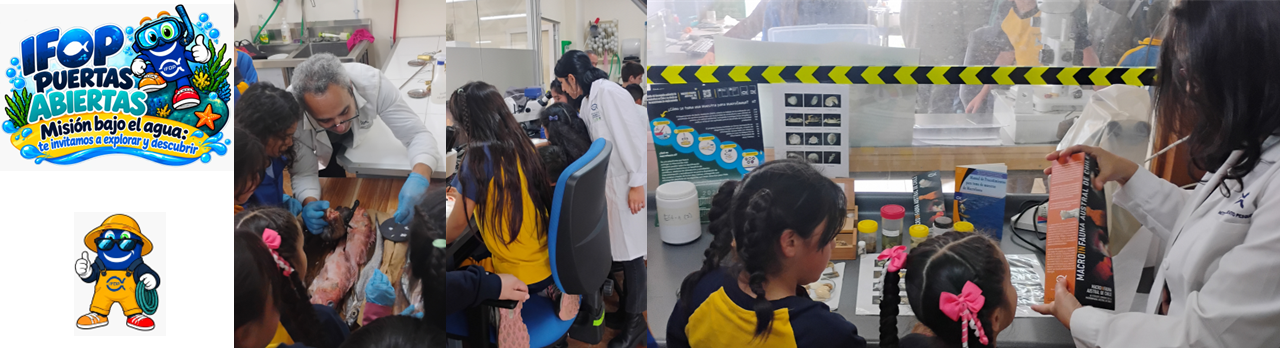
 The first “IFOP Open House: Mission Underwater” event gave students from the Pichicolo School an inside look at the scientific work conducted by the Institute—covering fisheries, aquaculture, and environmental research—through laboratory tours, biological samples, and specialized equipment.
Puerto Montt, October 22 – How is the age of a fish determined? What organisms inhabit the water column and the seabed? How are harmful algal blooms and invasive species studied? These were some of the topics explored by students from the Pichicolo School during the first “IFOP Open House: Mission Underwater”—an outreach initiative hosted by the Puerto Montt regional branch of the Fisheries Development Institute (IFOP).
Organized by the Aquaculture Division, the event aimed to bring scientific research closer to the school community through educational experiences that allowed students to engage directly with the work of the Institute’s researchers, professionals, and analysts. The tour highlighted IFOP’s technical capabilities and the contributions made by its research and monitoring programs toward understanding the country’s aquatic ecosystems and hydrobiological resources.
The day began with a welcome from Gastón Vidal, head of IFOP’s Aquaculture Division, who emphasized the importance of fostering an early interest in science, aquatic ecosystems, and the sustainability of marine resources. Before the tour commenced, Dennis Cisternas, a member of the Joint Health and Safety Committee, provided a safety briefing to guide the group on how to navigate the facility, including essential safety protocols and potential risks associated with the technical areas and laboratories.
The event was coordinated by senior researcher Nicole Pesse, who led the organization of the initiative. To introduce the topics, students were given an explanation of how the food web functions, with a focus on specific links in the chain that they would later encounter during their tour of the laboratories.
From the laboratory to the ecosystem: understanding how scientific information is generated
A key focus of the tour was to demonstrate that the knowledge required to understand and manage fishery resources is built through specific scientific procedures and the systematic collection of biological data.
At the fisheries station, José Pérez, coordinator of the Fisheries Division, introduced various fish species and explained how data relevant to their assessment and management are obtained. Students learned about procedures for measuring length and weight, as well as the extraction and analysis of otoliths—structures used to study the age and growth of fish. They also examined gonads, which are studied to determine reproductive characteristics and stages.
These experiences illustrated how biological observations and measurements are transformed into scientific information that contributes to our understanding of fish populations and the management of fishery resources.
The tour also covered the diversity of microscopic and macroscopic organisms that inhabit aquatic environments, highlighting their importance to ecosystem function and to productive activities such as fishing and aquaculture.
Environmental monitoring for understanding aquatic ecosystems
The stations managed by the Department of the Environment showcased various research and monitoring initiatives focused on organisms present in the water column and on the seabed, as well as processes critical to environmental management and aquaculture operations.
Loreto López, a professional analyst with the Red Tide Monitoring Program at the Regional Center for Environmental Studies (CREAN)—along with the program’s team of analysts—presented information on marine phytoplankton and harmful algal blooms (HABs). This session highlighted the significance of these organisms and events for aquatic ecosystems, as well as their connection to fishing, aquaculture, and the necessity of having scientific data for ongoing monitoring. For his part, researcher Mario Ortiz addressed the study of phytobenthos and the issues associated with *Didymosphenia geminata*—known as “Didymo”—a freshwater microalga that can form extensive blooms and alter the conditions of the environments where it becomes established. The students learned about the importance of biosecurity and the preventive measures required to stop it from spreading between bodies of water.
At the zooplankton station, presented by Macarena Herrera—a researcher with the Mytilid Larval Monitoring Program—attendees were able to observe biological samples and organisms under a microscope. Through these hands-on experiences, the relationship between phytoplankton and zooplankton was explained, as was the role these organisms play in aquatic food webs. The session also covered the importance of bivalves and their connection to ecological processes that support resources of interest for both aquaculture and human consumption.
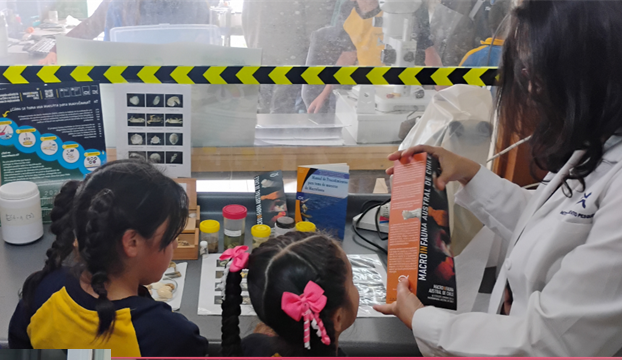
At the benthic macrofauna station, Sandra Silva, a senior analyst with the Aquaculture Environmental Performance Program, showcased organisms associated with the seabed and aquaculture farming sites. Using samples and materials from a biological collection, she explained how studying these communities contributes to our understanding of benthic ecosystems.
The event also served to introduce the scientific outreach platform www.macrofauna.cl, which is dedicated to disseminating information about the organisms that inhabit the country’s benthic ecosystems.
Taken together, these stations demonstrated how IFOP’s monitoring and research programs generate knowledge regarding the biological diversity and dynamics of aquatic ecosystems. Continuing these lines of work is essential for providing the scientific data needed to study environmental changes and to help assess the environmental performance of the aquaculture industry.
Aquatic Animal Health and Field Research Tools
María Paz Navarrete, a professional analyst in the Department of Aquatic Animal Health, presented research on fish parasites. Using samples and educational materials, she explained the relationships between hosts and parasites, highlighting their importance for understanding the biology and health of aquatic organisms.
The event concluded with a display of photographs and scientific equipment, presented by Sebastián Cook, a researcher from the Department of Repopulation and Cultivation. This segment offered a look at the tools used by researchers and analysts in the field to carry out monitoring and assessment activities within aquatic ecosystems. These various experiences demonstrated that scientific research requires the integration of field observations, sample analysis, specialized procedures, and biological knowledge. They also provided students with exposure to the tools and methodologies that IFOP uses to study aquatic biological resources and their environments.
Engagement with the educational community: sharing scientific knowledge
The first “IFOP Open House: Mission Underwater” event brought together expertise from the Aquaculture Division, the Fisheries Division, the Environment Department, the Aquatic Health Department, and the Repopulation and Cultivation Department at the Puerto Montt Regional Office.
This collaborative effort offered an integrated view of the institution’s work—ranging from the study of fish populations and microscopic organisms to environmental monitoring, aquatic health, and fieldwork.
The initiative serves as an opportunity to strengthen the relationship between IFOP and local educational communities, bringing applied research closer to children and young people through hands-on experiences. It also highlights the institution’s scientific capabilities and the value of its research and monitoring programs in understanding Chile’s aquatic ecosystems.
Through this initial event, IFOP Puerto Montt has created a platform for ongoing scientific outreach and knowledge transfer, fostering a closer connection between research, education, and the community. In doing so, the Institute helps the next generation understand how scientific information is generated and why it is essential for comprehending, assessing, and supporting the sustainable management of the country’s aquatic resources and ecosystems. The studies that gave rise to this activity are part of the Permanent Program for Fisheries and Aquaculture (Fisheries Law 20.657). This program is carried out under an agreement signed annually between the Undersecretariat of Economy and Small Businesses and the Fisheries Development Institute (IFOP), with the Undersecretariat of Fisheries and Aquaculture serving as the scientific-technical counterpart—we extend our gratitude for their support and coordination.
For further information on the studies conducted by IFOP, please visit www.ifop.cl.