
4 September 2026
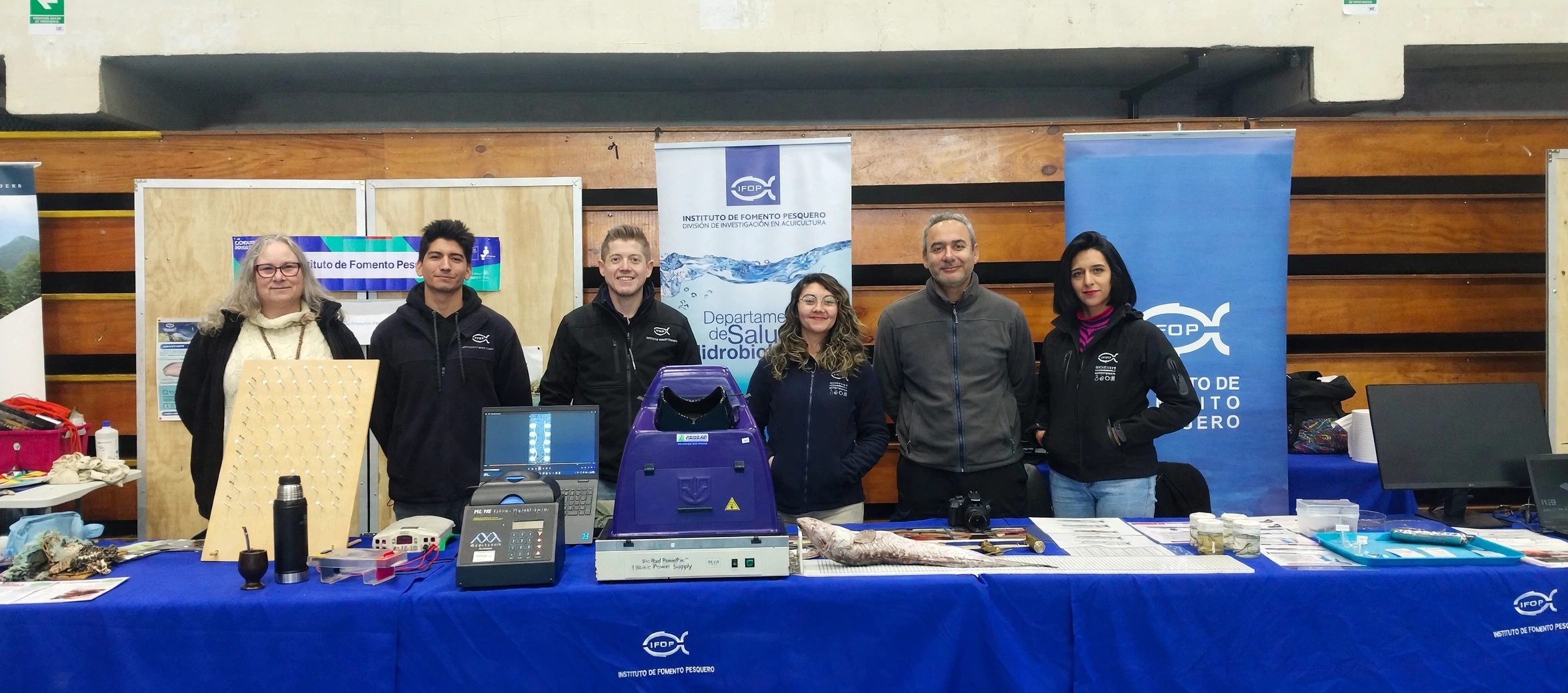 Professionals from the Aquaculture and Fisheries Research Divisions participated in a scientific dissemination day organized by PAR Explora Los Lagos, bringing students and teachers closer to the work carried out by the Institute in hydrobiological health, environment, fluvial, estuarine, and marine ecosystems, aquaculture, and fisheries.
With the purpose of bringing scientific research closer to the new generations and strengthening the bond between public research and educational communities, professionals from the Fisheries Development Institute (IFOP) participated on August 26 and 27 in the XXII Regional School Research and Innovation Congress, organized by the Regional Associative Project (PAR) Explora Los Lagos, at the Arena Puerto Montt facilities. The activity gathered more than 800 attendees, including students, teachers, academics, researchers, and representatives from various institutions linked to science, education, and innovation in the region, consolidating itself as one of the main meeting spaces for school scientific dissemination.
IFOP’s participation allowed students, teachers, and educational communities to learn, through demonstrative and interactive experiences, about part of the research and tools used to generate scientific information on marine, fluvial, and estuarine aquatic ecosystems, fishery resources, and processes associated with aquaculture.
More than presenting scientific results in an expository manner, the initiative sought to show how knowledge is built that subsequently contributes to understanding, monitoring, and supporting the management of the country’s aquatic resources and ecosystems. In this context, scientific dissemination constitutes a relevant tool to bring research closer to society and encourage new generations to understand the existing link between science, territory, and productive activities.
Applied research that reaches the classrooms
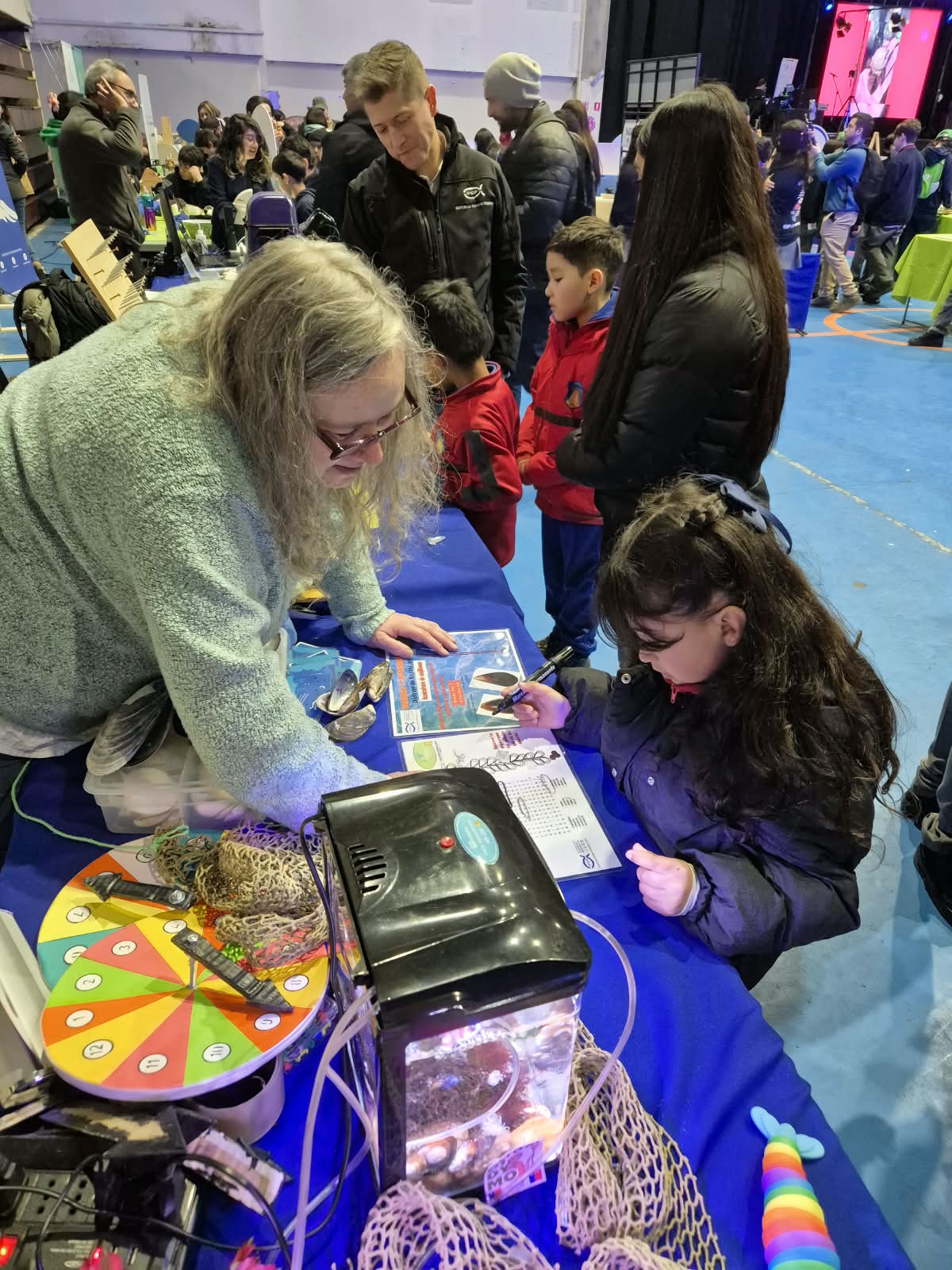 During both days, IFOP set up an interactive space organized into thematic stations, where professionals from its different areas shared knowledge and experiences linked to hydrobiological health, the environment, fisheries, and aquaculture.
From the Department of Hydrobiological Health, Dennis Cisternas, María Paz Navarrete, and Katherine Subiabre developed demonstrations related to procedures used in research and diagnosis, including molecular analysis, PCR techniques, bacterial cultures, and macroparasite studies. These activities allowed students to get closer to methodologies that are part of the processes through which information is obtained to evaluate the health status of aquatic organisms and systems.
Meanwhile, from the Department of Environment, Mario Ortiz and Macarena Herrera addressed content related to fluvial, estuarine, and coastal ecosystems, highlighting the importance of understanding the connection between these environments and the productive activities that depend on them. Mario Ortiz explained the case of Didymo (Didymosphenia geminata), an exotic microalga considered a pest that spreads in fresh watercourses, whose dispersion is limited upon reaching the physicochemical conditions of estuarine waters at river mouths. Likewise, he explained prevention measures to avoid its dispersion, raising awareness among the audience regarding the associated environmental risks and the importance of monitoring invasive species and pests of ecological relevance for the conservation of aquatic ecosystems. All of this was presented through an aquarium with a live Didymo bloom, a microscope to observe the cellular appearance of this pest species, and an educational model designed to teach about the various tourism activities carried out in rivers and how these activities can contribute to the dispersion and propagation of this microalga in fluvial ecosystems.
On her part, Macarena Herrera presented the existing link between estuarine systems and mussel farming, using the empirical model of the mouth of the Puelo River, an aquarium with organisms native to the marine benthos to discover part of the epiphytic community of mussel seed collectors as settlement units in mytilid seed collection areas, and other games that allow content integration in a playful way. The researcher explained how these environments provide favorable conditions for seed settlement that later support regional aquaculture production, also highlighting the contribution of public science through dissemination tools such as the interactive platform Semilla Endémica, which allows bringing this knowledge closer to the educational community and the general public.
Meanwhile, the Fisheries Division, represented by José Pérez with the support of Katherine Subiabre, carried out practical demonstrations using instruments employed in fisheries research, such as ichthyometers and scales, in addition to a real-time dissection of a golden kingclip. The activity allowed explaining directly how biological information on fishery resources is obtained and its usefulness for the knowledge and monitoring of fisheries.
The importance of integrating research and scientific dissemination
One of the main contributions of this initiative was the coordinated participation of professionals from the Aquaculture and Fisheries Research Divisions, allowing them to present a broad view of IFOP’s scientific work to the school community.
This integration is particularly relevant in a territory like the Los Lagos Region, where fishing and aquaculture activities maintain a close relationship with environmental conditions and coastal ecosystems. Understanding these interactions requires generating knowledge from different disciplines and, at the same time, communicating it in an accessible way to those who inhabit and carry out their activities in these territories.
For IFOP, bringing this knowledge closer to students and teachers also represents an opportunity to make the role of applied public research visible, showing that behind the information used to understand hydrobiological resources and support decision-making, there is scientific work that involves observation, sampling, analysis, experimentation, and systematic data generation.
In this way, dissemination activities not only spark interest in marine sciences, but also help educational communities recognize the value of scientific research in addressing environmental, productive, and social challenges present in their own territories.
A perspective from PAR Explora Los Lagos
“From the Regional Associative Project Explora Los Lagos, we are tremendously grateful for the participation of around twenty institutions from our region’s science ecosystem, as in the case of the Fisheries Development Institute, because with creativity, patience, and much dedication, they accompanied us and helped bring relevant knowledge and information about the work IFOP does to many children, young people, and also teachers who were the protagonists of the two days of socialisation of science, knowledge, technology, and innovation at the twenty-second School Research and Innovation Congress, held at the Arena Puerto Montt events center.”
— Daniela Pradenas Field, Communications Manager, Regional Associative Project (PAR) Explora Los Lagos
New opportunities to bring science to the territory
The experience developed in the XXII Regional School Research and Innovation Congress constitutes an instance that can project towards new collaboration and scientific dissemination actions, especially considering the diversity of research lines developed by IFOP and the need to strengthen meeting spaces between researchers, educational communities, and territories.
In this sense, participation in initiatives of this type allows identifying new opportunities to generate educational activities, scientific demonstrations, and knowledge-sharing spaces, helping students learn firsthand about the work of those who research the ecosystems and resources that form part of their environment.
The connection with educational communities thus constitutes a complementary component of applied research: while scientific programs generate information to understand and support the management of hydrobiological resources, dissemination actions allow sharing that knowledge with society and strengthening a scientific culture linked to the territory.
The joint participation of the Aquaculture and Fisheries Research Divisions in this activity also reaffirms the importance of integrating capabilities and disciplines to communicate IFOP’s scientific work, bringing research closer to new generations and contributing to forming a more informed citizenry regarding the challenges facing the fisheries, aquaculture, and environmental sectors.