

28 September 2026
 This concept reinforces the commitment to achieving sustainability in the fishing sector—encompassing both capture fisheries and aquaculture—by promoting the responsible use of resources and the conservation of ecosystems.
The blue economy, which seeks to derive value from the seas while protecting ecosystem health, offers significant opportunities to boost our country’s fisheries exports. Chile possesses the natural conditions, scientific capabilities, and extensive production and management expertise to sustainably capitalize on new avenues for sectoral development linked to marine conservation, blue carbon, and climate change adaptation.
The blue economy concept reinforces the commitment to sustainability in the capture fisheries and aquaculture sectors, promoting responsible resource use and ecosystem conservation. “This enables the sector to realize its growth potential, shifting from volume-based production to a model that generates greater value through innovation, technology adoption, product diversification, and the development of both domestic and international markets,” the statement notes.
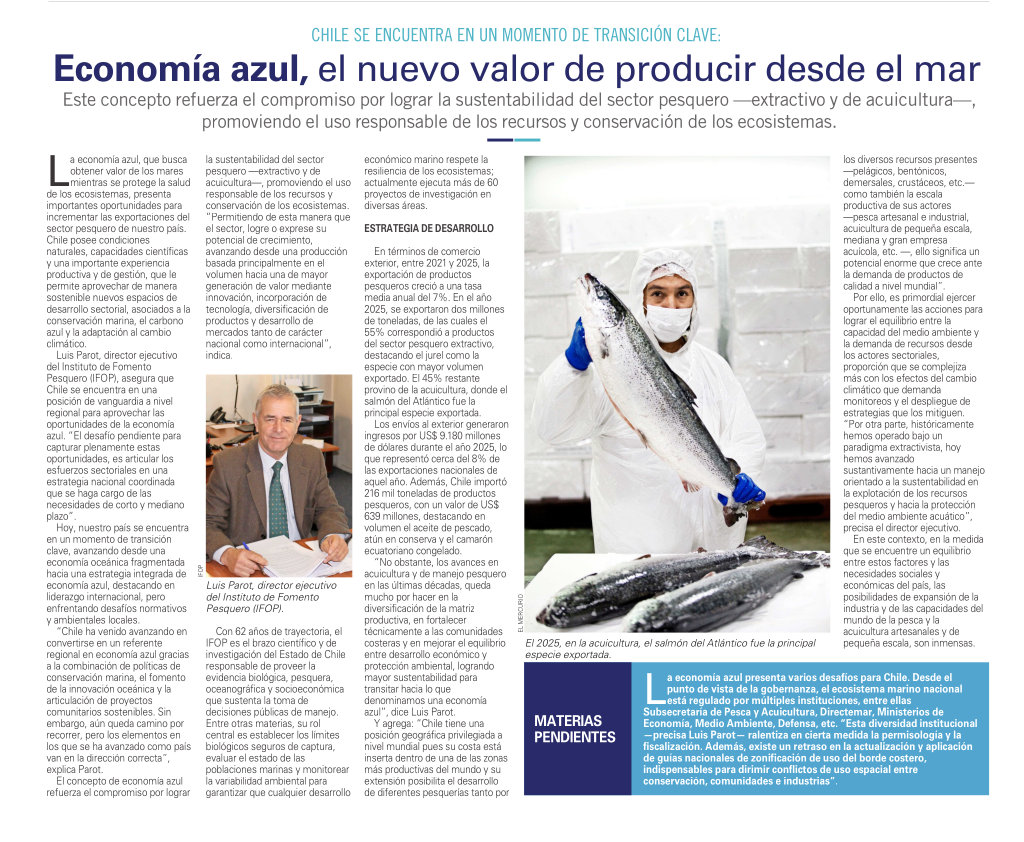
Luis Parot, Executive Director of the Fisheries Development Institute (IFOP), asserts that Chile is at the forefront of the region in terms of seizing blue economy opportunities. “The remaining challenge to fully capturing these opportunities is to coordinate sectoral efforts into a unified national strategy that addresses both short- and medium-term needs.”
Today, our country is at a pivotal transition point, moving from a fragmented ocean economy toward an integrated blue economy strategy; while it stands out for its international leadership, it also faces local regulatory and environmental challenges. “Chile has been making strides toward becoming a regional leader in the blue economy, thanks to a combination of marine conservation policies, the promotion of ocean innovation, and the coordination of sustainable community projects. While there is still work to be done, the progress made as a country is moving in the right direction,” explains Parot.
With a 62-year history, IFOP serves as the Chilean State’s scientific and research arm, responsible for providing the biological, fisheries, oceanographic, and socioeconomic evidence that underpins public management decisions.
Among other functions, it plays a central role in establishing safe biological catch limits, assessing the status of marine populations, and monitoring environmental variability to ensure that any marine economic development respects ecosystem resilience; it currently carries out more than 60 research projects across various fields.
In terms of foreign trade, fishery product exports grew at an average annual rate of 7% between 2021 and 2025. In 2025, two million tons were exported; 55% of this volume came from the extractive fishing sector—with jack mackerel standing out as the species with the highest export volume—while the remaining 45% originated from aquaculture, led by Atlantic salmon.
Overseas shipments generated US$9.18 billion in revenue in 2025, representing nearly 8% of the country’s total exports for that year. Additionally, Chile imported 216,000 tons of fishery products valued at US$639 million, with fish oil, canned tuna, and frozen Ecuadorian shrimp standing out in terms of volume. “Despite advances in aquaculture and fisheries management over recent decades, much remains to be done to diversify the production base, technically strengthen coastal communities, and improve the balance between economic development and environmental protection—thereby achieving greater sustainability as we transition toward what we call a ‘blue economy,’” says Luis Parot.
He adds: “Chile enjoys a privileged global geographic position, as its coastline lies within one of the world’s most productive zones. Its vast extent enables the development of diverse fisheries—driven by the variety of available resources (pelagic, benthic, demersal, crustaceans, etc.) and the range of operational scales (artisanal and industrial fishing, small-scale aquaculture, and medium- to large-scale aquaculture enterprises). This represents enormous potential that is growing in response to global demand for quality products.”
Therefore, it is crucial to take timely action to strike a balance between environmental capacity and the resource demands of sectoral stakeholders—a dynamic further complicated by the effects of climate change, which necessitate monitoring and the implementation of mitigation strategies.
“Moreover, while we have historically operated under an extractivist paradigm, we have now made significant strides toward sustainability-oriented management of fishery resources and the protection of the aquatic environment,” notes the executive director.
In this context, provided a balance is struck between these factors and the country’s social and economic needs, the potential for industry expansion—as well as for the growth of the artisanal and small-scale fishing and aquaculture sectors—is immense.
The blue economy presents several challenges for Chile. Regarding governance, the national marine ecosystem is regulated by multiple institutions, including the Undersecretariat of Fisheries and Aquaculture, Directemar, and the Ministries of Economy, Environment, and Defense, among others.
“This institutional diversity,” explains Luis Parot, “slows down permitting and oversight processes to some extent. Furthermore, there is a lag in updating and implementing national guidelines for coastal zone usage—tools that are essential for resolving spatial conflicts between conservation efforts, local communities, and industry.”
PENDING ISSUES
The blue economy presents several challenges for Chile. Regarding governance, the national marine ecosystem is regulated by multiple institutions, including the Undersecretariat of Fisheries and Aquaculture, Directemar, and the Ministries of Economy, Environment, and Defense, among others. “This institutional diversity,” explains Luis Parot, “slows down permitting and oversight processes to some extent. Furthermore, there is a lag in updating and implementing national guidelines for coastal zone usage—tools that are essential for resolving spatial conflicts between conservation efforts, local communities, and industry.”
Source: El Mercurio de Santiago