
28 September 2026
 An online workshop presented results from projects linked to oceanographic dynamics, water exchange, environmental monitoring, and forecasting applied to aquaculture.
On Friday, September 25, the Fisheries Development Institute (IFOP) held the 2025–2026 Results Dissemination Workshop titled “Oceanography and numerical modeling as tools to support aquaculture management.”
The event was organized by the Environment Department of IFOP’s Aquaculture Research Division and aimed to share key results from projects developed by the Oceanography and Climate Group based in Putemún, Castro.
The meeting covered studies regarding the oceanographic conditions of southern channels and fjords and their applications for aquaculture management.
Oceanography and numerical modeling projects
Among the work presented was the project “Water exchange scales in Chilean Patagonia fjords and channels, 2025–2026,” which aimed to generate data on the dynamics of these systems.
Also presented was the “Atmospheric and oceanographic forecasting system, 2025–2026,” which addressed forecasting tools to support the analysis of environmental conditions.
The third line of work focused on the “Monitoring and modeling of spatial and temporal variability of oceanographic processes in southern channels and fjords, 2025–2026,” aiming to characterize the variability of oceanographic processes within these ecosystems.
Workshop Program
The program began with opening remarks from the Undersecretariat of Fisheries and Aquaculture, followed by a welcome address from Alejandra Oyanedel Pérez, Head of the Environment Department within IFOP’s Aquaculture Research Division.
Next, Susana Giglio Muñoz, from the Undersecretariat’s Aquaculture Division, presented an overview of oceanography projects, their lines of work, and their funding sources.
The session continued with a presentation titled “How does estuarine dynamic respond to interannual variability in its main drivers? Case study: fjords adjacent to GAM,” delivered by Camila Soto-Riquelme, a researcher at IFOP’s Putemún Research Center.
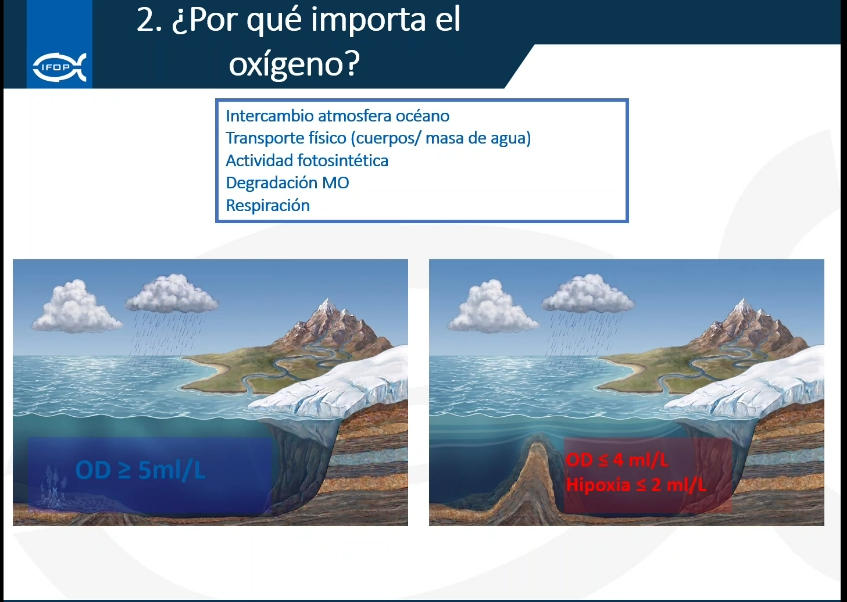
Subsequently, Gabriel Soto Soto, a researcher at the Putemún Research Center, discussed dissolved oxygen as an indicator of ecosystem health, examining the contrasts between the Almirante Montt Gulf (GAM) and the Taraba Fjord.
“Monitoring allows us to detect deep-water anoxia, identify ventilation pulses, quantify recovery and deterioration processes, and estimate long-term trends. It also enables us to distinguish between stable systems, such as the Taraba Fjord, and more vulnerable ones, like the inner GAM area. Furthermore, it helps identify conditions of persistent hypoxia, prolonged anoxia, and recurring low-ventilation events,” he noted.
He also highlighted that the system’s most significant changes occur on timescales that cannot be captured through isolated sampling campaigns. “The recurring detection of hypoxia and anoxia in deep waters does not necessarily result in direct mortality, but it serves as an indicator of ecosystem vulnerability—particularly when faced with other stressors such as high temperatures and harmful algal blooms,” he maintained.
He added that cutting back on long-term monitoring means losing the ability to detect deoxygenation processes at an early stage, especially in the most vulnerable systems of Chilean Patagonia. The program also featured a presentation titled “Oceanographic Forecasts and Operational Applications,” delivered by Cristian Ruiz Soto, a researcher at the Putemún Research Center.
The researcher noted that “the ISA virus crisis (2007–2009) highlighted the need for more environmental data regarding Chilean Patagonia—a region historically challenging to study”—due to factors such as meteorological, logistical, and environmental conditions.
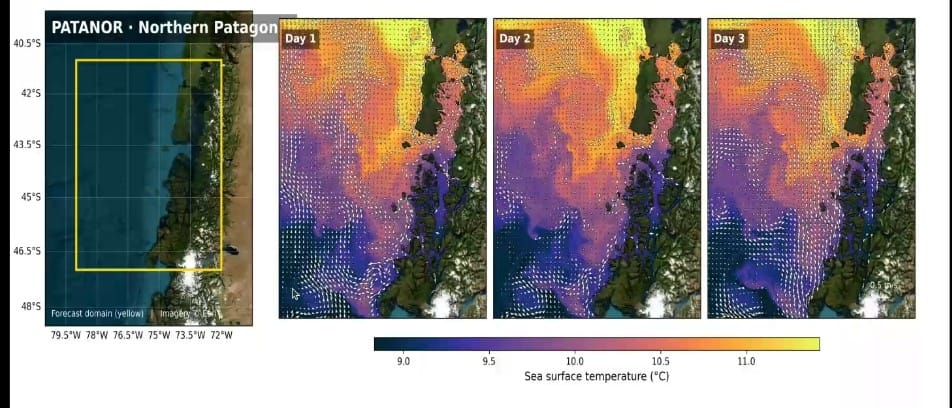
“MOSA is IFOP’s operational oceanographic and atmospheric forecasting model; it uses numerical modeling to predict ocean and atmospheric conditions in Patagonia up to 72 hours in advance. It operates continuously, providing three-day forecasts of oceanographic and atmospheric variables for northern and southern Patagonia, which are available via the Chonos system. The models reproduce regional variability, the seasonal cycle, and estuarine circulation; the main discrepancies are associated with freshwater input and surface stratification,” commented Cristian Ruiz.
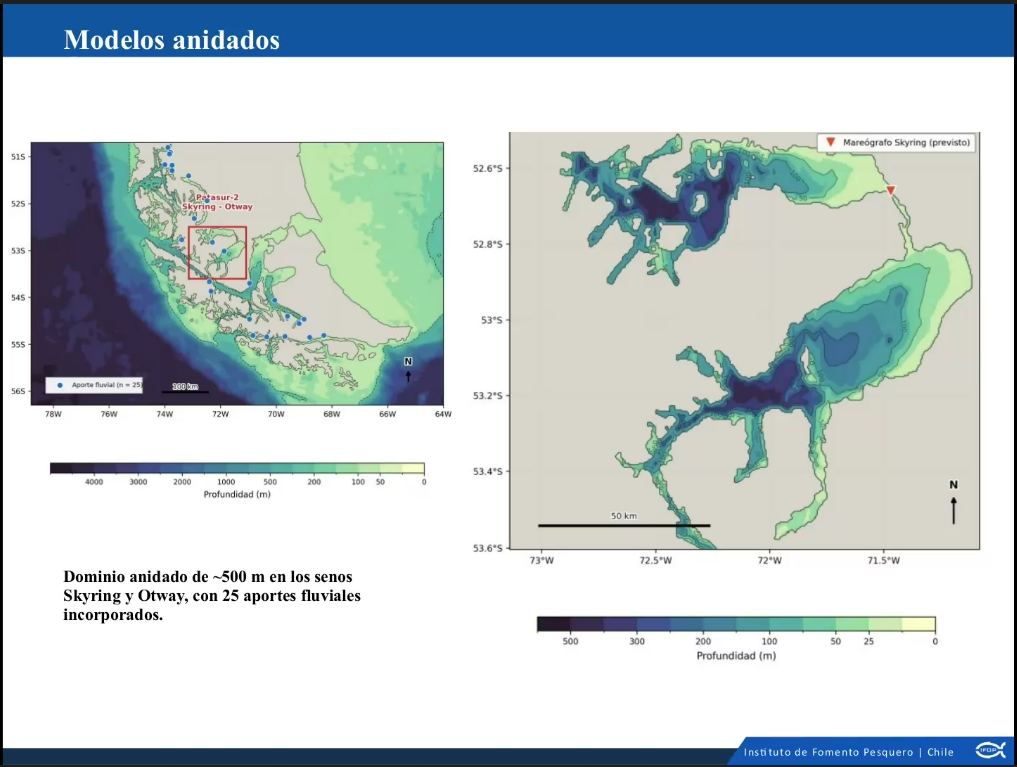
He adds that “derived tools (PartiMOSA, FLOW) extend their application to contingency management and spatial planning. Nested models and the 1-km atmospheric model increase resolution in areas of interest for aquaculture.”
PartiMOSA is an interactive web-based tool and module developed by Chile’s Institute of Fisheries Development (IFOP). Its primary function is to simulate and predict the trajectory and dispersion of inanimate or passive particles within the inland waters of Chilean Patagonia (specifically in the Los Lagos, Aysén, and Magallanes regions).
Finally, regarding challenges, Cristian Ruiz highlighted the need to “implement data assimilation from the oceanographic buoy network; couple ocean, atmospheric, and hydrological models—for instance, using the FLOW hydrobiological model for flow forcing; and strengthen computational capacity to run high-resolution configurations.”
He also noted the need to “improve the representation of freshwater and stratification, particularly in southern Patagonia. Furthermore, nested models—whose baroclinic evaluation is still pending—must be operationally integrated, alongside expanding and standardizing observational coverage for validation purposes.”
The event concluded with a Q&A session and the closing of the workshop.
Source: Aqua
https://www.aqua.cl/oceanografia-y-pronosticos-ifop-aborda-herramientas-para-la-gestion-acuicola/