

25 May 2026
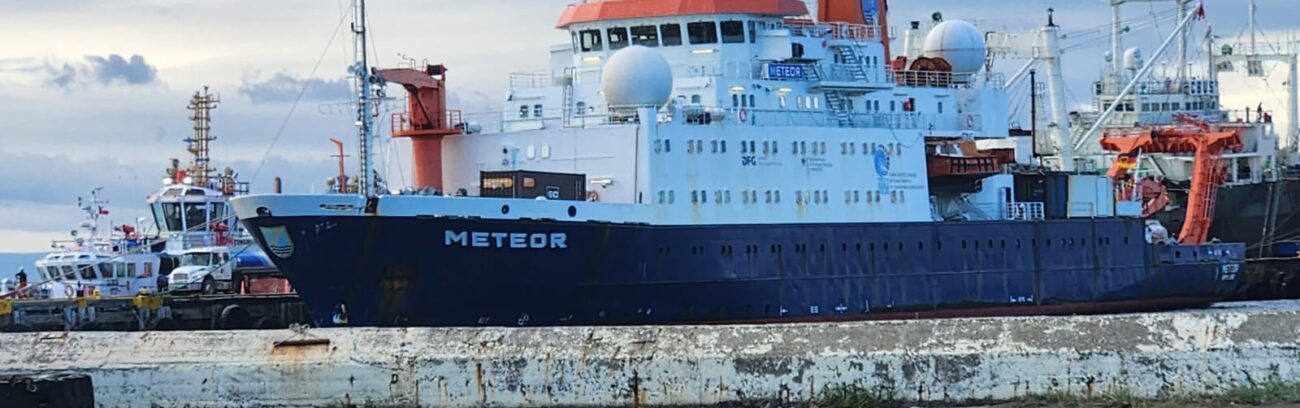
From April 2nd to May 6th, 2026, Pamela Carbonell A., a researcher at the Center for the Study of Harmful Algae (CREAN) of the Aquaculture Division based in Puerto Montt, participated in the scientific expedition aboard the German vessel METEOR. The expedition covered a 2,500-nautical-mile transect, departing from Punta Arenas and calling at the port of San Vicente in the Biobío Region.
The expedition, identified as TRACK-HAB (“Tracking the footprint of an extreme harmful algal bloom event”), campaign M218, was a unique experience that allowed researchers to address relevant questions and gain a better understanding of the interaction between microalgal assemblages and the biological, physical, and chemical variables of the area.
Furthermore, this opportunity fosters collaborative work between Chilean scientists with extensive experience studying harmful algal blooms (HABs) in our country, and between German and Chilean researchers, enabling the exchange of knowledge, scientific progress, and fraternity between citizens of both countries.
Scientific Basis for Understanding HABs in Chile
Throughout this expedition, 82 sampling stations were collected in the fjords and channels of southernmost Patagonia, as well as in the open ocean, reaching distances of 50-60 nautical miles and maximum depths of up to 2760 meters. A comprehensive set of measurements will allow for a detailed analysis of the structural and functional diversity of microbial communities, with particular attention to phytoplankton species in the water column and sediments, and the hydrographic and biogeochemical conditions of the water masses that host these communities. This will enable us to better understand and explain the emergence of these communities in their specific environments.
IFOP’s Participation
Participating in this expedition was a valuable experience, allowing us to share the work of the entire Red Tide team with national and international colleagues. We highlighted the importance of the monitoring programs carried out between the Biobío and Magallanes regions, emphasizing the coverage area, number of stations, sampling frequency, monitored variables, and the recent incorporation of digital tools to provide timely information to communities. At the end of this expedition, a comprehensive qualitative and quantitative analysis of dinoflagellate cysts will be conducted along this transect, yielding unprecedented data from underexplored areas. This analysis will be carried out by Pablo Salgado, a researcher at CREAN-Punta Arenas, in collaboration with Gemita Pizarro, a researcher at the same institution.
Acknowledgments
We would like to acknowledge the tremendous support of so many colleagues, which made this expedition possible without incident. My thanks to Pablo Salgado, Gemita Pizarro, Roberto Raimapo, Claudia Zamora, Marcela Jaramillo, Luis Molina, César Alarcón, Héctor Tardón, Erik Daza, Oscar Espinoza and Sergio Flores.
Press related links: