
16 April 2026
The meeting established the initial guidelines for defining the Ocean Node’s governance model.
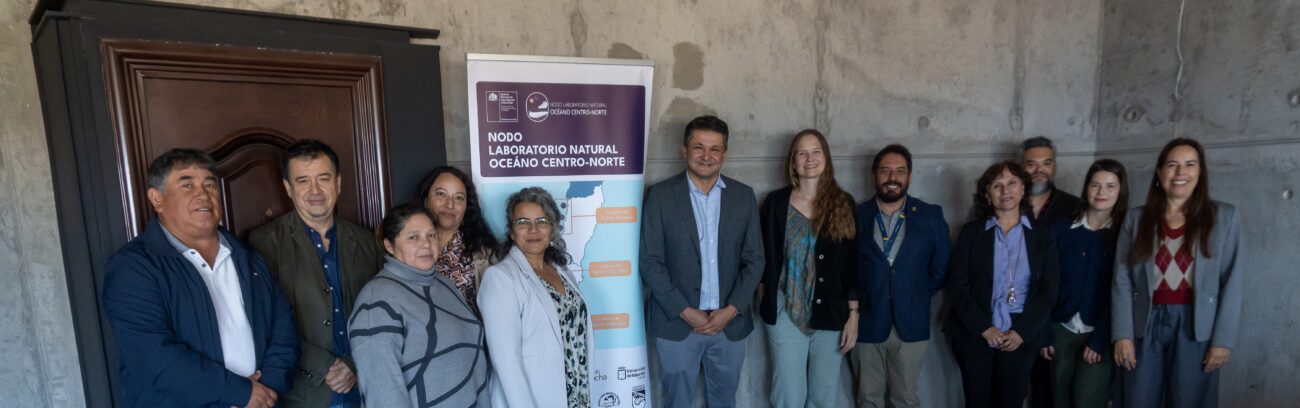
The Faculty of Natural and Exact Sciences at the University of Playa Ancha hosted the first governance meeting led by the North Central Ocean Natural Laboratory Node (Ocean Node). Representatives from the project’s partner institutions, the National Research and Development Agency (ANID), and the CIV-VAL Node participated.
Impact on the Territories
The meeting aimed to inform and co-design a governance model for the Ocean Node. The initiative, its components, challenges, and next steps were presented, ultimately leading to the identification of the initial guidelines that will shape its governance.
Among the key elements identified were the need for balanced representation of stakeholders, promoting a two-way flow of information between the territory and communities, science and public policy, maintaining a focus on the real needs and challenges of the territory, and uniting existing scientific efforts in the regions and institutions.
In this regard, the director of the Ocean Node, Marcelo Olivares Arenas, stated that “this governance meeting allows us to plan the best way to coordinate efforts, so that the world-class science that is being conducted and planned can have an impact on the territories of the central and northern coastal zone of Chile.”
Likewise, Dr. Verónica Molina Trincado, Deputy Director of the Ocean Node and General Director of the UPLA Environmental HUB, stated that this first milestone aimed to “identify the areas where we can leverage all the work that has been done over these years, in order to generate an impact in the territories,” highlighting in this context the focus on the Node’s six priority areas of work: Oceanography, Marine and Coastal Biodiversity, Local Knowledge, Networking and Knowledge Transfer, Sustainable Blue Economy, and Territorial Governance.
Importance of Collaboration
The National Confederation of Artisanal Fishermen of Chile (CONAPACH) valued the development of this space, emphasizing the importance of a permanent link between academia and the fishing industry, as stated by the confederation’s treasurer, Miguel Ávalos Medina.
“These opportunities for participation are extremely rewarding and also solidify the possibility that the artisanal fishing sector, together with academia, can contribute to civil society, science, and the results we hope to achieve with this Node,” stated the treasurer of CONAPACH.
Among the perspectives that emerged from the meeting, the importance of inter-institutional collaboration to generate a real impact on public policy through the work of the Ocean Node was highlighted.
In this regard, the coordinator of the CIV-VAL Node, Kinga Halmai Zapata, noted that “initiatives like these allow us to complement and identify strategic points to visualize the next steps in these two ANID instruments, which are of great importance to our country.”
Participating Institutions
It is worth noting that this initiative is led by the Catholic University of the North (UCN), through its Institute of Public Policy and the UCN Faculty of Marine Sciences, along with the University of Playa Ancha (UPLA), the Pontifical Catholic University of Valparaíso (PUCV), the University of Valparaíso (UV), the University of Atacama (UDA), the Center for Advanced Studies in Arid Zones (CEAZA), the National Confederation of Artisanal Fishermen of Chile (CONAPACH), and the Fisheries Development Institute (IFOP).