
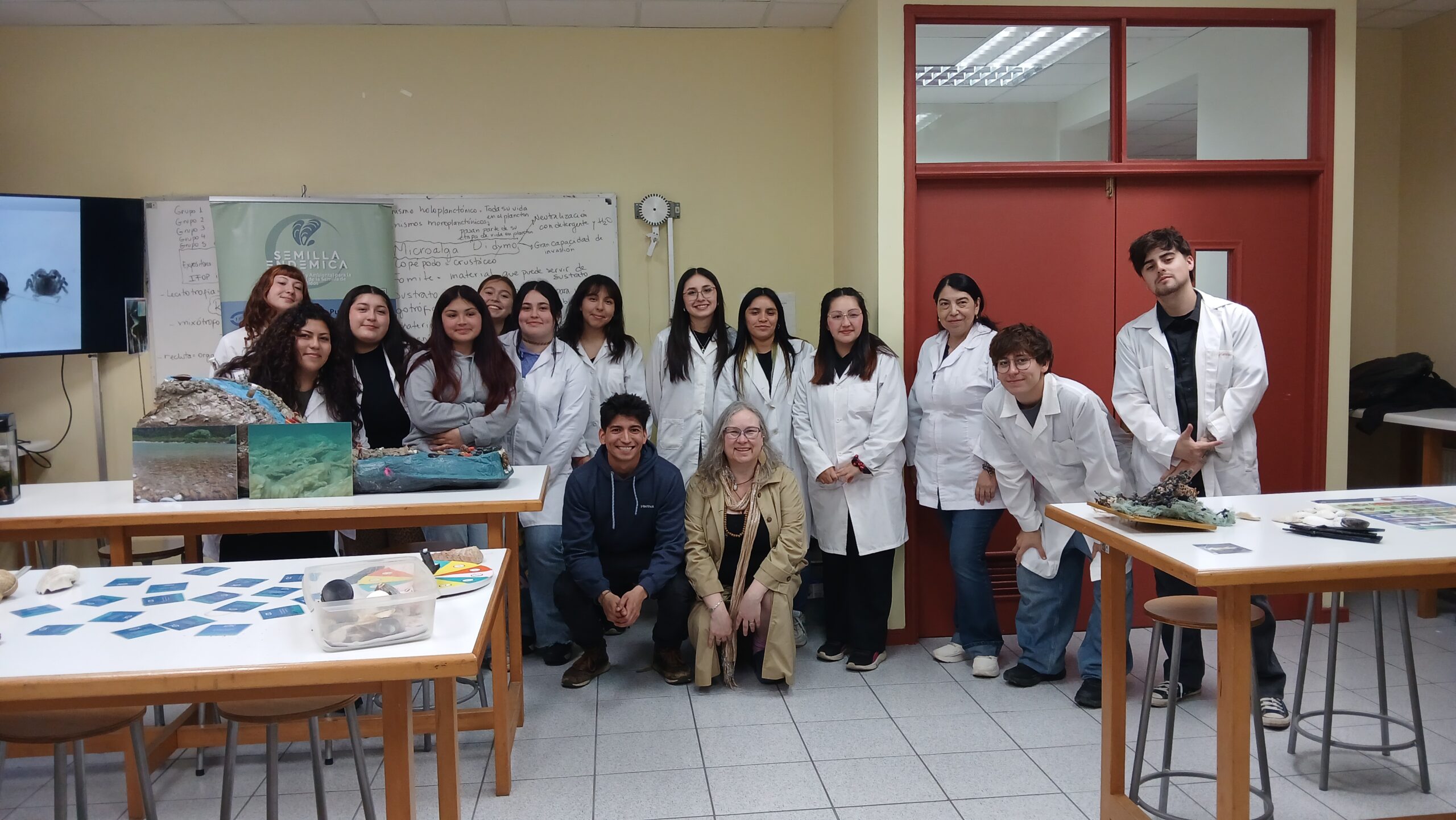
 The Fisheries Development Institute (IFOP) participated on Friday, November 21, in a training session with second-year students of the Bachelor of Education in Primary Education program at the Austral University of Chile (UACh), Puerto Montt campus. The activity took place at the Faculty of Sciences and Nature on the Pelluco Campus and aimed to enrich initial teacher training with direct experiences related to aquatic ecosystems, their functioning, and their relevance to the Los Lagos Region.
The invitation was extended by Professor Fabiola Rojel, instructor of the course “Structure and Function of Living Beings in the Ecosystem.” She noted that there is a persistent gap in initial teacher training regarding the study of aquatic ecosystems, because textbooks and traditional materials prioritize terrestrial environments. In this regard, IFOP’s expertise in marine and freshwater ecology makes a significant contribution to strengthening science education in coastal regions like southern Chile.
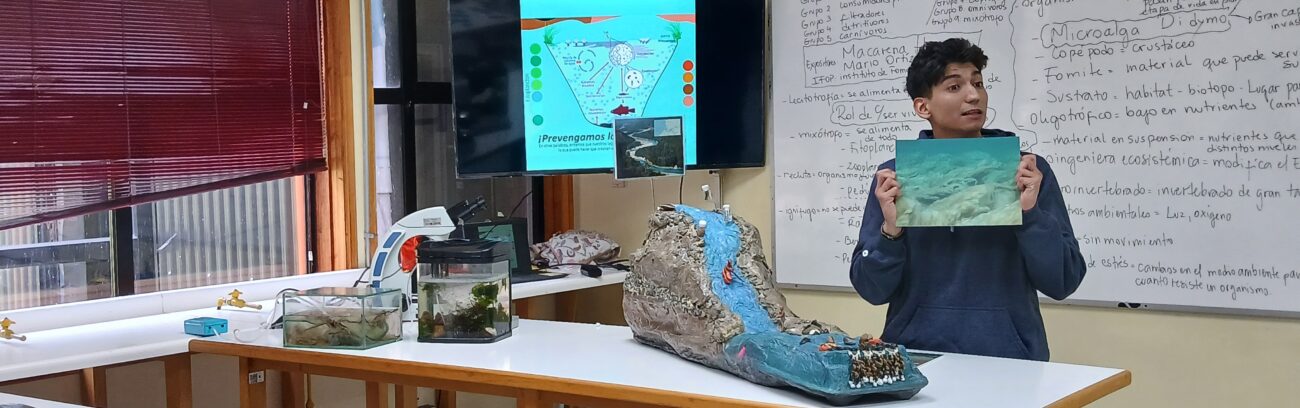
Representing IFOP, researchers Mario Ortiz and Macarena Herrera from the Environmental Department of the Aquaculture Research Division conducted a hands-on workshop with two groups of students, providing an educational experience based on observation, analysis, and direct contact with biological material. The activity aligned with the course’s learning outcomes, covering key concepts such as ecosystem hierarchies, functional dynamics, interspecies interactions, ecosystem services, human impact, and environmental sustainability.
The professionals presented IFOP’s work in monitoring aquatic ecosystems and assessing benthic resources, focusing on the technical knowledge surrounding mussel larvae monitoring and the Didymo Monitoring Program. They explained how this research allows for a better understanding of the role of producer organisms, population fluctuations, and the complexity of food webs. Furthermore, they addressed specific examples from the region, highlighting the relationship between human activity—including aquaculture—and the natural balance of marine and freshwater systems.
The event brought together students and academics interested in gaining a deeper understanding of this invasive species, its propagation dynamics, and the monitoring processes associated with its habitats, ecosystem impacts, and links within the food webs of aquatic systems.
One of the most valued aspects of the day was the incorporation of interactive activities, adapted from previous experiences with children but now geared toward the university level. Through simulation games, participants modeled how species from both habitats are linked, identifying them taxonomically and their different roles. These exercises allowed for the concrete integration of ecological interactions observed in the field and the recognition of patterns that are typically analyzed only from technical data.
In addition, group activities were developed where students acted out roles within an aquatic food web—from producers to top predators. This methodology facilitated the assimilation of complex content and strengthened an integrated understanding of ecosystem processes.
Students had the opportunity to observe benthic organisms, microscopic structures, and representative samples from different levels of biological organization, which facilitated the understanding of concepts such as individual, population, community, habitat, and ecosystem. This practical approach allowed theory to be transformed into experience, reinforcing learning through inquiry and direct contact with real elements of the regional environment.
Academic Fabiola Rojel highlighted the importance of the meeting, stating that “IFOP’s presence allows students to access an updated and contextualized scientific perspective, essential for training teachers capable of teaching ecology from a territorial perspective.” She also expressed her gratitude for the professionals’ availability and commitment demonstrated during the event.
For IFOP, this activity represents a valuable opportunity to connect with teacher training, strengthening the dissemination of scientific knowledge and promoting a deeper understanding of the region’s aquatic ecosystems. The institution reaffirms its commitment to continue collaborating with educational institutions and contributing to the development of professionals prepared to educate about the ocean and its ecological dynamics.
Press related links: