

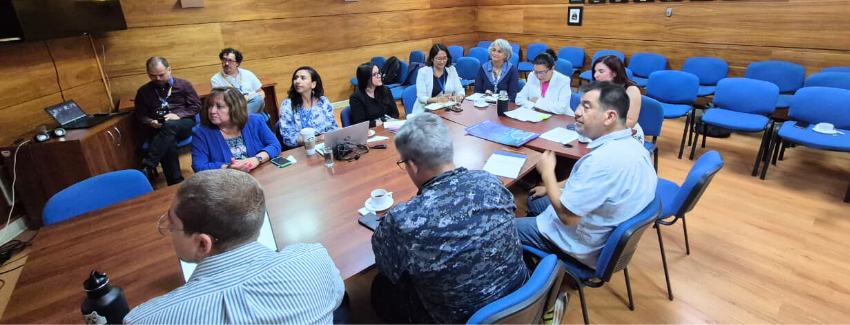
The National Inter-institutional Committee for Environmental Contingencies (CIICA), coordinated by the National Fisheries and Aquaculture Service (Sernapesca), held its first session of 2026. The purpose of the session was to continue the coordinated and integrated work among the agencies that comprise the committee and to coordinate with the Inter-institutional Committees in the Los Lagos, Aysén, and Magallanes regions in response to abnormal fishing and aquaculture events, strengthening communication between public agencies in the event of emergencies.
During the session, researchers from the Fisheries Development Institute (IFOP) gave a presentation on the Alert, Prediction, and Observation System (S.A.P.O.) for fisheries resilience in a climate change scenario. and the forecasts for the coming months regarding climatic and oceanographic conditions, in addition to monitoring the microalgae situation in the southern zone.
In the South Pacific, positive anomalies or increases in sea surface temperature (SST) persist, intensifying even with greater spatial coverage, an abnormal situation for this time of year. This situation has triggered alerts from the authorities of the countries in the South Pacific basin.
Therefore, according to updated observations from the beginning of March, the abnormally warm ocean condition has taken hold and intensified from the Gulf of California to the northern part of the Los Lagos Region. However, from the Puerto Montt area southward, including the inland sea of the Aysén and Magallanes Regions, temperatures remain within normal ranges.
This is consistent with a condition similar to that observed at the beginning of the 2023/2024 Coastal El Niño. In fact, in Peru, the Multisectoral Committee in Charge of the National Study of the El Niño Phenomenon (ENFEN), in its February 27 bulletin, declared a “Coastal El Niño Alert” due to abnormally warm temperatures along the Equatorial Pacific, the coasts of Peru, and northern Chile.
Regarding indicators, in south-central Chile, the inland and coastal seas of the Los Lagos and Aysén regions, temperatures remain within normal ranges for this time of year, but with chlorophyll-a concentrations below normal for this time of year (<2 mg/m3), affecting a large area.
However, the situation is dynamic and is under continuous monitoring through the SAPO system, which considers the possibility that south-central Chile could experience warmer-than-normal conditions due to the Coastal El Niño event that is beginning to develop along most of the Pacific coast of the Americas.
For this reason, Sernapesca, in conjunction with various institutions, is activating the relevant mechanisms, such as the CIICA, to assess the situation and adopt appropriate measures.
“The public services involved are monitoring the rising ocean temperatures to adjust all the preventative action plans we have developed in conjunction with the stakeholders and to be prepared for any contingencies that could affect fishing and aquaculture activities, minimizing the impacts. Access to updated scientific information provided by the monitoring systems of IFOP and the Navy has been key to this,” commented Soledad Tapia Almonacid, National Director of Sernapesca, adding that this information has been made available to aquaculture companies, who are already prepared to implement their contingency plans if necessary.
It is worth remembering that the presence of El Niño on the coasts of Chile has brought with it, in other seasons, changes in meteorological and oceanographic conditions, with varying effects on hydrobiological resources and marine ecosystems, such as, for example, the increase in sea temperature above normal values, with positive anomalies that can vary between 2° to 4°C or more; the weakening of the coastal upwelling that normally brings cold and nutrient-rich waters to the coastal zone and eventually; the increase in Harmful Algal Bloom (HAB) events, among others.
These conditions could have potential effects on economic activities such as extractive fishing and aquaculture, including mortalities in fish farms; a decrease in catches of species such as anchovy and sardine; and changes in the distribution and abundance of resources, altering the food web.
Sernapesca, in coordination with various institutions, such as CIICA, will maintain the relevant mechanisms to assess the evolving situation, provide timely information, and adopt appropriate measures in response to risk conditions, in conjunction with the relevant sectoral stakeholders.