

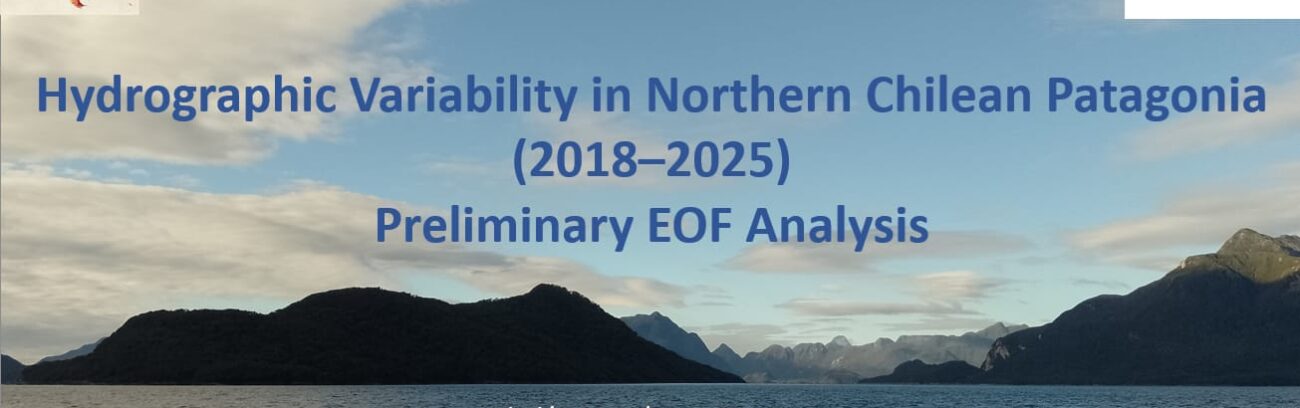
 Entre el 24 y el 28 de noviembre, el investigador de IFOP, Cristián Henríquez Pastene participó en el 3rd International Congress on Physical of Estuarine and Coastal Ocean en Puerto Varas, donde presentó el trabajo:
“Hydrographic Variability in Northern Chilean Patagonia (2018–2025): Preliminary EOF Analysis”
En esta instancia, el investigador pudo intercambiar experiencias y conocimientos con expertos nacionales e internacionales especializados en oceanografía física costera y de estuarios, fortaleciendo así redes de colaboración para nuestra institución.
Su investigación aplica el método de Funciones Ortogonales Empíricas a datos hidrográficos recolectados durante otoño, entre 2018-2025, en la región de Los Lagos y Aysén, para comprender cómo la variabilidad ambiental interanual podría influir en la distribución de recursos pelágicos en la Patagonia norte.
Estos análisis complementan los estudios previos basados en SIG y Modelos GAM, al incluir la variabilidad temporal, pudiendo eventualmente aplicarse a otros proyectos similares.
El autor agradece el financiamiento otorgado por el Programa PACAN-PAVAN (Convenio 2025) y a los colegas del Departamento de Evaluaciones Directas por su constante apoyo.
Hydrographic Variability in Northern Chilean Patagonia (2018–2025): Preliminary EOF Analysis
Cristián Henríquez-Pastene (1), Javier Legua (1), Alejandro Cárdenas (2), Jairo Gutiérrez (1), Adrián Ibieta (1), Manuel Rojas (1), René Vargas (1) y Jorge Castillo (1)
(1) Departamento de Evaluaciones Directas, Instituto de Fomento Pesquero, Valparaíso, Chile. cristian.henriquez@ifop.cl
(2) Departamento de Gestión de Muestreo. Instituto de Fomento Pesquero. Aysén, Chile.
Northern Chilean Patagonia, between the Interior Sea of Chiloe (MIC) and the Aysén region, supports a highly productive pelagic ecosystem with key fishery species such as southern sardine (Sprattus fuegensis), anchoveta (Engraulis ringens), and common sardine (Strangomera bentincki). From 2018 to 2025, autumn surveys combined hydroacoustic prospection and oceanographic sampling to assess species dynamics in relation to the water column’s physicochemical structure. Previous studies using GIS and Generalized Additive Models (GAMs) helped identify spatial patterns, but their point-based approaches are limited in capturing regional and temporal coherence. This study introduces a complementary methodology based on Empirical Orthogonal Function (EOF) analysis to identify dominant modes of spatiotemporal variability across zones. A common horizontal grid was created for all cruises, and CTD profiles (0–100m) were interpolated using kriging, masking areas distant from observational data. This standardized matrix enabled EOF analysis on potential temperature (θ), absolute salinity (SA), potential energy anomaly (PEA), freshwater content (FWC), and Brunt–Väisälä frequency (BV), revealing robust vertical and horizontal hydrographic structures. A exploratory EOF applied to θ and SA showed that the first modes explained 50%–70% of the total variance. Temporal signals from leading modes were compared with acoustic biomass of target species to explore physical–biological relationships. However, data gaps from unsampled areas limit EOF’s ability to resolve continuous temporal patterns; this limitation highlights the need to incorporate and validate complementary data from oceanographic models such as GLORYS V12. Despite these gaps, the EOF analysis revealed interannual pulses of stratification and oceanic intrusion. These hydrographic shifts may indirectly modulate pelagic species distributions through effects on water column stability and habitat structure. This approach offers a valuable tool for advancing multiyear physical–biological coupling in complex estuarine systems.
Funding: ASIPA Project (2025): Evaluación Hidroacústica de Pequeños Pelágicos en Aguas Interiores de las Regiones de Los Lagos y Aysén del General Carlos Ibáñez del Campo.