

Red de Instituciones de Investigación Pesquera y Acuícola de los Países Miembros de la Alianza del Pacífico

Instituto de Fomento Pesquero
Instituto Tecnológico CORFO / Instituto Tecnológico Público
OFFICIAL NAME:
Marine Institute of Peru
HEADQUARTERS:
Callao
LEGAL CONSTITUTION:
Legislative Decree No. 95, Law of the Marine Institute of Peru – IMARPE
YEAR OF ESTABLISHMENT: 1964
DirectorateResearch AreaLine of Work
GENERAL DIRECTORATE OF PELAGIC RESOURCES RESEARCHFunctional Area of Pelagic Neritic Resources Research
  • Monitoring of biological, fishery, and population indicators of pelagic fish in relation to the marine environment. (Daily information published on the IMARPE website).
  • Study of the main reproductive aspects of marine fish and invertebrates: reproductive cycle and size at first gonadal maturity, reproductive indicators, etc.
  • Topics related to the Inter-American Tropical Tuna Commission (IATTC).
Functional Area of Transboundary and Highly Migratory Resources
  • Biology and fisheries of transboundary species in relation to their habitat in jurisdictional waters and high seas of the Southeast Pacific.
  • Research on the mahi-mahi resource and billfish.
Functional Area of Population Dynamics and Pelagic Resource Assessment
  • Implementation and application of indirect assessment models for major pelagic resources.
  • Onboard Observer Program.
  • Seasonal and spatial variations in abundance and prey consumption by guano birds.
  • Abundance, distribution, and population structure of the South American fur seal and sea lion on the Peruvian coast. Marine mammal sightings during cruises. Interactions with fishing operations.
  • Monitoring of sea turtles in the northern zone (Piura): Estimation of relative abundance and feeding ecology.
GENERAL DIRECTORATE OF DEMERSAL AND LITTORAL RESOURCES RESEARCHFunctional Area of Demersal, Benthic, and Littoral Fish Research
  • Response to mass mortality events and strandings on the Peruvian coast.
  • Monitoring of artisanal fishing potential through the Artisanal Fishery Information Collection System, determining fishing effort and spatio-temporal variation of catch per unit effort of main species by fishing gear.
  • Research on the trophic spectrum of major fishery resources and their spat-temporal variations to understand the trophodynamics of the Peruvian sea.
  • Research on age and growth of major fishery resources to estimate parameters and length-age keys for application in population assessment models.
  • Population assessment of main demersal resources – Hake and other demersal resources assessment cruise.
Functional Area of Marine Invertebrates and Macroalgae Research
  • Project “Strengthening of scientific bases for the development of the jumbo squid fishery,” R.M. N°552-2017-PRODUCE.
  • Research and monitoring of the biology, fisheries, and population dynamics of main marine invertebrate and macroalgae resources, emphasizing jumbo squid, for fishery management recommendations.
  • Assessment of marine invertebrate populations through direct and indirect methods for estimating abundance and its spatio-temporal fluctuations.
  • Research on marine macroalgae.
Functional Area of Biodiversity Research
  • Inventory of marine fish, invertebrate, and macroalgae communities to contribute to the knowledge and valuation of the country’s biological diversity, and to monitor the natural variability of biodiversity-based ecological indicators against potential impacts from anthropogenic interventions or natural events like El Niño.
  • Research on species and ecosystems in the Peruvian sea as technical elements that contribute to guaranteeing their conservation, in accordance with national and international concepts, principles, and agreements.
GENERAL DIRECTORATE OF AQUACULTURE RESEARCHFunctional Area of Coastal Marine Research
  • Assessment of Environmental State-Pressure and Response, as well as environmental quality in the coastal marine zone.
  • Evaluation and analysis of ecotoxicology in organisms and environmental matrices.
  • Research on Marine Litter (Macro, meso, and microplastics).
  • Geographic Information Systems (GIS).
  • Research for management in the coastal marine zone (Marine spatial planning, adaptive approach, ecosystem services, carrying capacity assessment).
Functional Area of Inland Water Resources Research
  • Population monitoring of the “river shrimp”.
  • Tracking of the Amazonian fishery.
  • Study of high-Andean fishery resources (reproductive biology of trout and silverside).
  • Fishery limnology studies in inland water bodies.

Functional Area of Aquaculture Research
  • Research for the expansion of the aquaculture frontier and sustained production applied in support of the aquaculture sector.
  • Research in biotechnology of aquatic organisms and its application in the aquaculture production sector.
  • Research for the transfer of cultivation technology to communities in High Andean and Amazonian zones.
GENERAL DIRECTORATE OF HYDROACOUSTICS, REMOTE SENSING, AND FISHING GEAR RESEARCH

Functional Area of Hydroacoustics

Functional Area of Fishing Gear

Functional Area of Remote Sensing


  • Application of the Hydroacoustic Method in Fishery Resource Assessment.
  • Development of Hydroacoustic Technologies for Aquatic Ecosystem Management.

Functional Area of Hydroacoustics

Functional Area of Fishing Gear

  • Research on environmentally safe fishing gear, methods, and systems and their impact on the ecosystem.
  • Research on traditional and non-traditional fishing gear.
Functional Area of Remote Sensing
  • Satellite monitoring of physical and biological processes of aquatic environments with the TeraScan station.
  • Strengthening of the SISESAT Fishing Vessel Satellite Monitoring System platform.
Scientific Support, Coordination, and Dissemination
  • Coordination and Administration of Research Scientific Technicians (TCI).
GENERAL DIRECTORATE OF OCEANOGRAPHIC AND CLIMATE CHANGE RESEARCHFunctional Area of Physical Oceanography Research
  • Study and monitoring of the effects of El Niño in the Marine Ecosystem off Peru:
    • Characterization of El Niño and La Niña manifestations and physical/biogeochemical monitoring based on in situ and satellite data for early warning.
    • Monitoring of biological indicators of water masses and plankton biodiversity off the coast.
    • Mechanisms contributing to coastal warming (winds, advection, trapped waves).
  • Impact of Climate Change on marine ecosystems off Peru: analysis, modeling, and adaptation:
    • Regional projections of climate change scenarios in physical, biogeochemical, and bioclimatic conditions.
    • Current and future vulnerability of fishery and aquaculture resources to climate change.
    • Paleo-reconstruction of past manifestations of climatic variations in the ecosystem associated with coastal upwelling and the oxygen minimum zone.
Functional Area of Chemical Oceanography and Geology Research
  • Integrated study of coastal upwelling off Peru:
    • Dynamic aspects of coastal upwelling: coastal wind, circulation, variability.
    • Biogeochemistry of coastal upwelling and the Oxygen Minimum Zone.
    • Productivity and phytoplankton communities associated with upwelling.
    • Benthic communities, sediment biogeochemistry, and benthic-pelagic coupling in the coast-ocean gradient.
Functional Area of Biological Oceanography Research
  • Integrated study of Physical, Chemical, and Biological processes in Coastal Edge Ecosystems:
    • Coastal circulation (data and modeling).
    • Characterization of phytoplankton and zooplankton associated with HABs (Harmful Algal Blooms) and conditioning abiotic factors.
    • Impacts of HABs on biogeochemical conditions and benthos of bays.
  • Fisheries Oceanography:
    • Larval survival studies of fishery resources with an emphasis on anchoveta in spawning areas and seasons.
    • Estimation of anchoveta spawning biomass based on the egg production method.
RESEARCH VESSELS
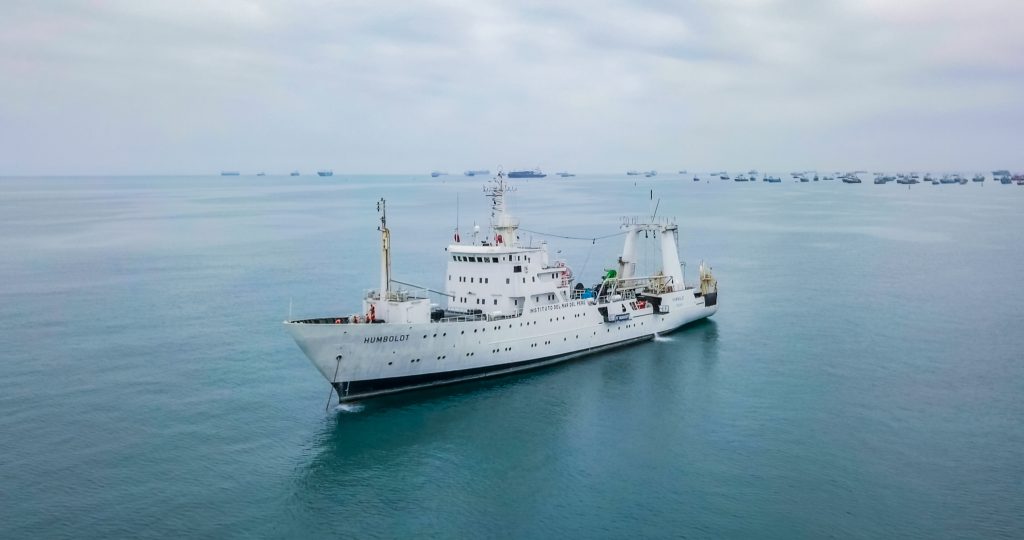
  • BIC Humboldt
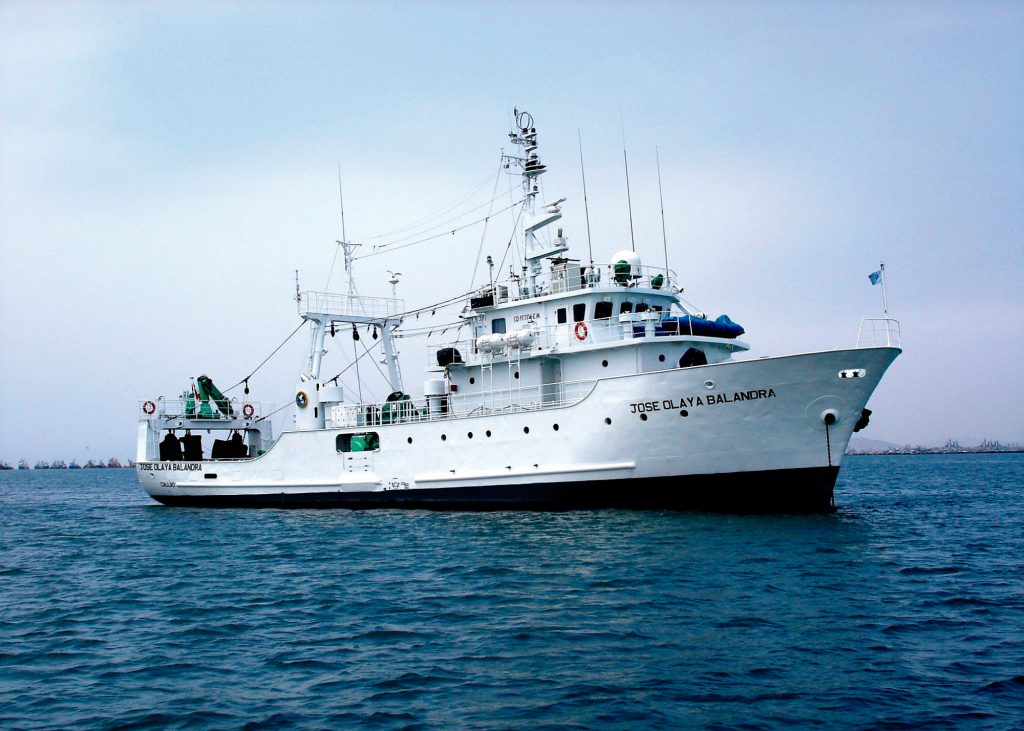
  • BIC José Olaya Balandra
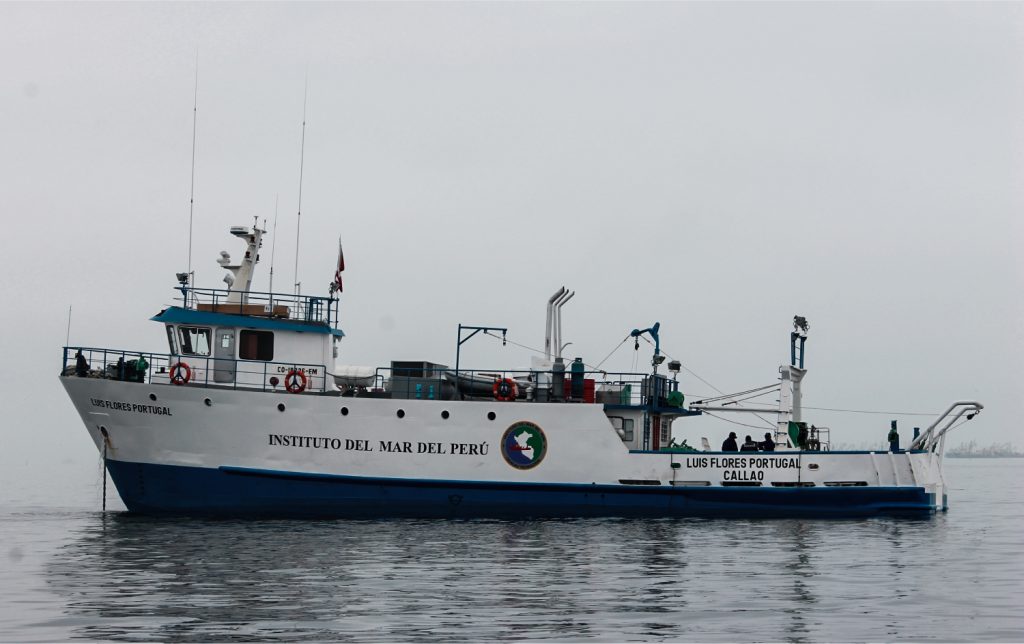
  • BIC Luis Alberto Flores Portugal
SMALL VESSELS
  • IMARPE III Launch
  • IMARPE IV
  • IMARPE V
  • IMARPE VI
  • IMARPE VIII
  • Señor de Sipán Boat
  • Don Paco Boat
  • Don Manuel Boat
Ultima modificación: Wednesday March 18th, 2026
Instituto de Fomento Pequero

Siguenos a través de redes sociales:

Edificio central IFOP: Almirante Blanco Encalada 839, Valparaiso. Chile.

© IFOP, CHILE. 2026. Todos los derechos reservados. Prohibida la reproducción total o parcial sin autorización escrita del propietario.